
The animals do not stand still for us. Heads lifted, bodies stretched, they seem to move along the same current. An object small enough to examine closely can still suggest a landscape beyond its edges.
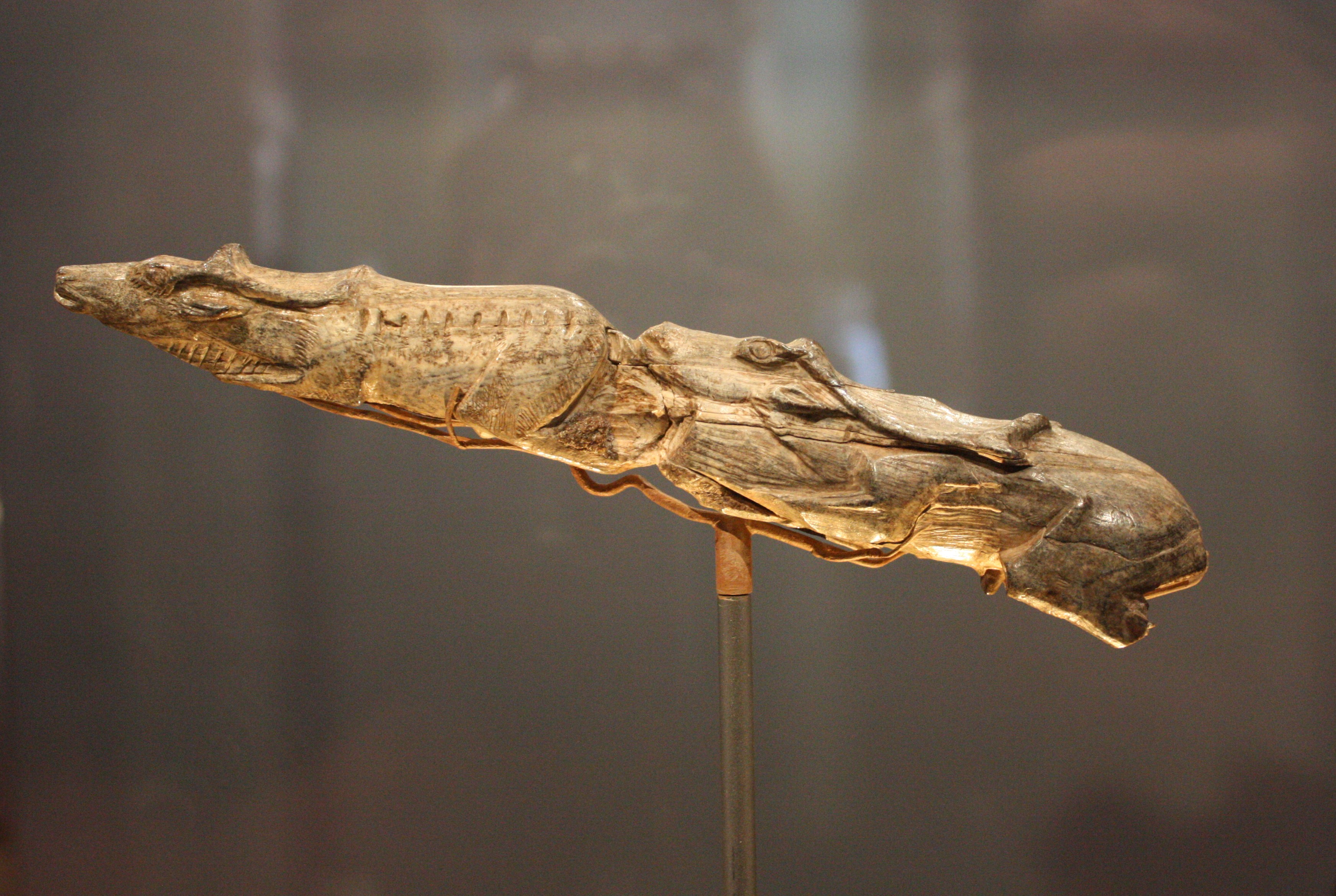
The Swimming Reindeer, Montastruc, France, about 13,000 years old. Mammoth ivory; British Museum, Palart.550. Photograph by Val, 2010; reproduced without alteration.

A reunion after thousands of years
The Swimming Reindeer was found in two pieces during excavations begun in 1866. The British Museum’s record says that Henri Breuil recognized their fit in 1905. Two fragments became a single composition: a female and a male reindeer, one behind the other. The work is carved from mammoth ivory and belongs to the late Ice Age. British Museum, Palart.550.
There is a good lesson in that reunion. The meaning of a line changes when its neighbour returns. What seems to be an ending may be a break. Looking at a museum object means looking at what survives, and sometimes at what someone has learned to put together again.
In this photograph, the join is visible. So are the support and the surrounding display space. Keeping them in the image makes the object’s present life legible. We are looking at an ancient carving through a modern act of preservation, not at an untouched moment in the distant past.
The Ice Age beyond the cave wall
Prehistoric art is often pictured as an image fixed to a cave. This is a different encounter: an animal body worked into another animal’s material. The British Museum identifies it as portable art. Its elongated form invites the eye to travel from one head to the next rather than settle into the front-facing composition of a picture. British Museum collection record.
The historical setting matters, but it does not give us the maker’s explanation. “Swimming” describes a persuasive reading of the posture. It should not become an invented eyewitness account of a particular crossing, a ritual, or a hunt. No surviving statement from the maker tells us what this object was meant to do.
Instead, we can attend to visible choices. The bodies are compressed into a long, narrow volume. Marks across the flank interrupt the smooth outline. The lifted heads are distinct from the sweeping backs. For a present-day designer, these choices suggest ways of conveying movement without filling the whole surface with detail.
A cup has no single front
A different movement: the bison turns back
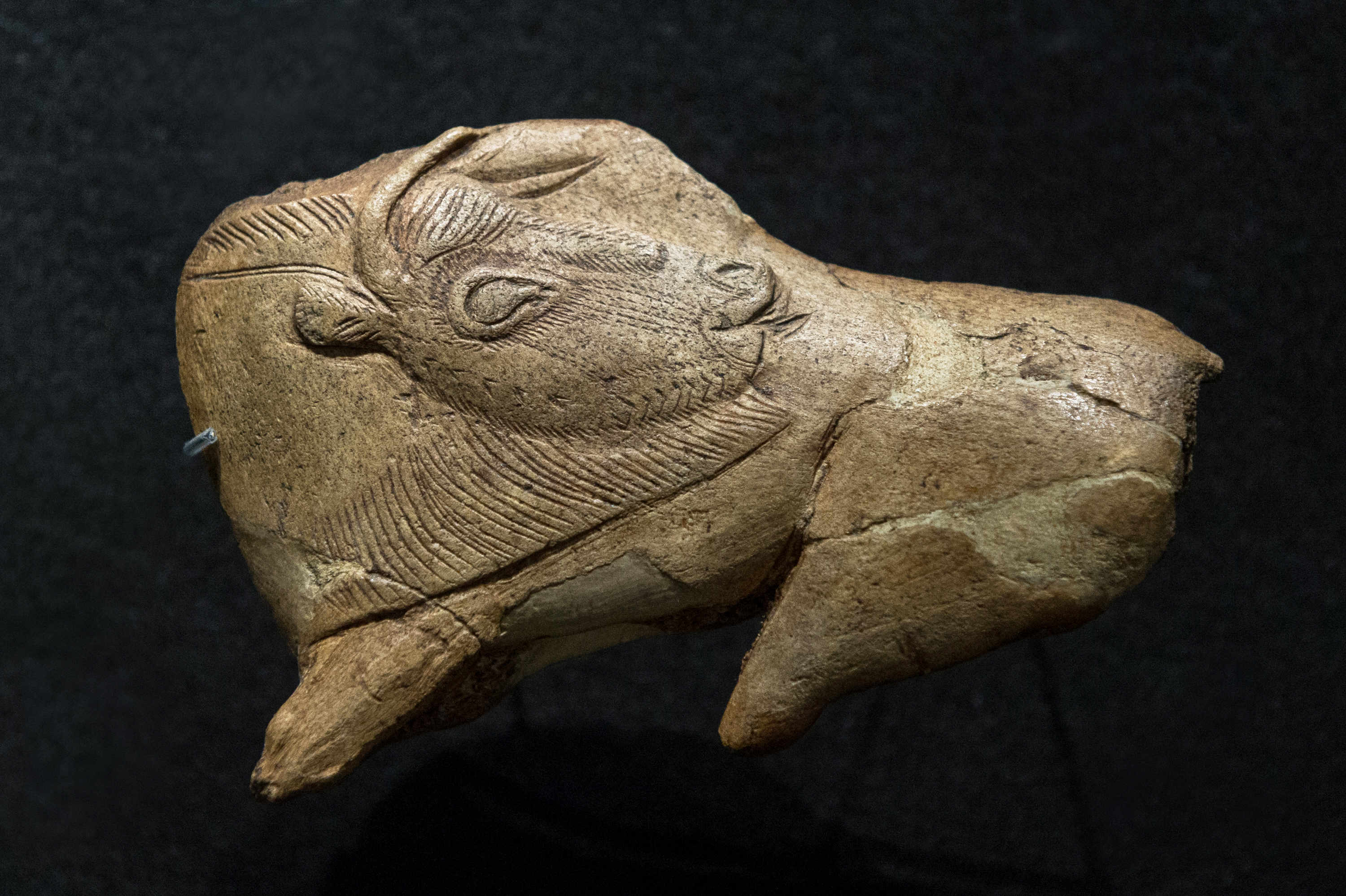
Bison licking its flank, La Madeleine, Dordogne, France. Magdalenian; carved reindeer antler. Musée national de Préhistoire, Les Eyzies. Photograph reproduced without alteration.

The Musée national de Préhistoire’s visitor guide identifies this small antler sculpture as a bison turning its head to lick its back. It belongs to the Magdalenian artistic tradition, rather than the exact moment or workshop of the reindeer carving. Here the movement folds inward. The head and shoulder make a compact composition, while closely spaced incisions distinguish hair from the smoother body.
For a relief, compare two options: the reindeer’s long contour could travel around the cup; the bison’s returning curve could inspire a single focused motif. Fine parallel grooves could describe one textured area without filling the whole surface. These are compositional lessons, not a proposal to reproduce an ancient object exactly.
Let the composition unfold
Turn a cup in your hand and the view unfolds. A long motif can leave sight on one side and return on the other. That makes the vessel a useful place to explore the carving’s sense of continuation.
Our study begins with a much simpler animal contour. A raised head, a stretched back, and a few angled marks do the work. The drawing is original, not a facsimile of either carved animal. Repetition changes the subject again: a paired sculpture becomes a frieze that circulates around a cup.
From history to cup / FORM study
A line that travels around the cup
Animal movement → an extended contour → a circulating frieze
01 / The repeat, unfolded
Let a long back and a lifted head carry the movement. Leave generous space between animals, with the join in that space.
Original FORM illustration, inspired by the object discussed above. Schematic lighting and placement, not a reconstruction or a mold-readiness result.
Imagine it in clay
A broad, quiet cup gives the animal contours space to travel. In this concept, the extended bodies become a shallow frieze rather than independent sculpture. The tile makes that change easier to see: a moving silhouette and a few rounded edges carry the image, without reproducing the ivory carving.
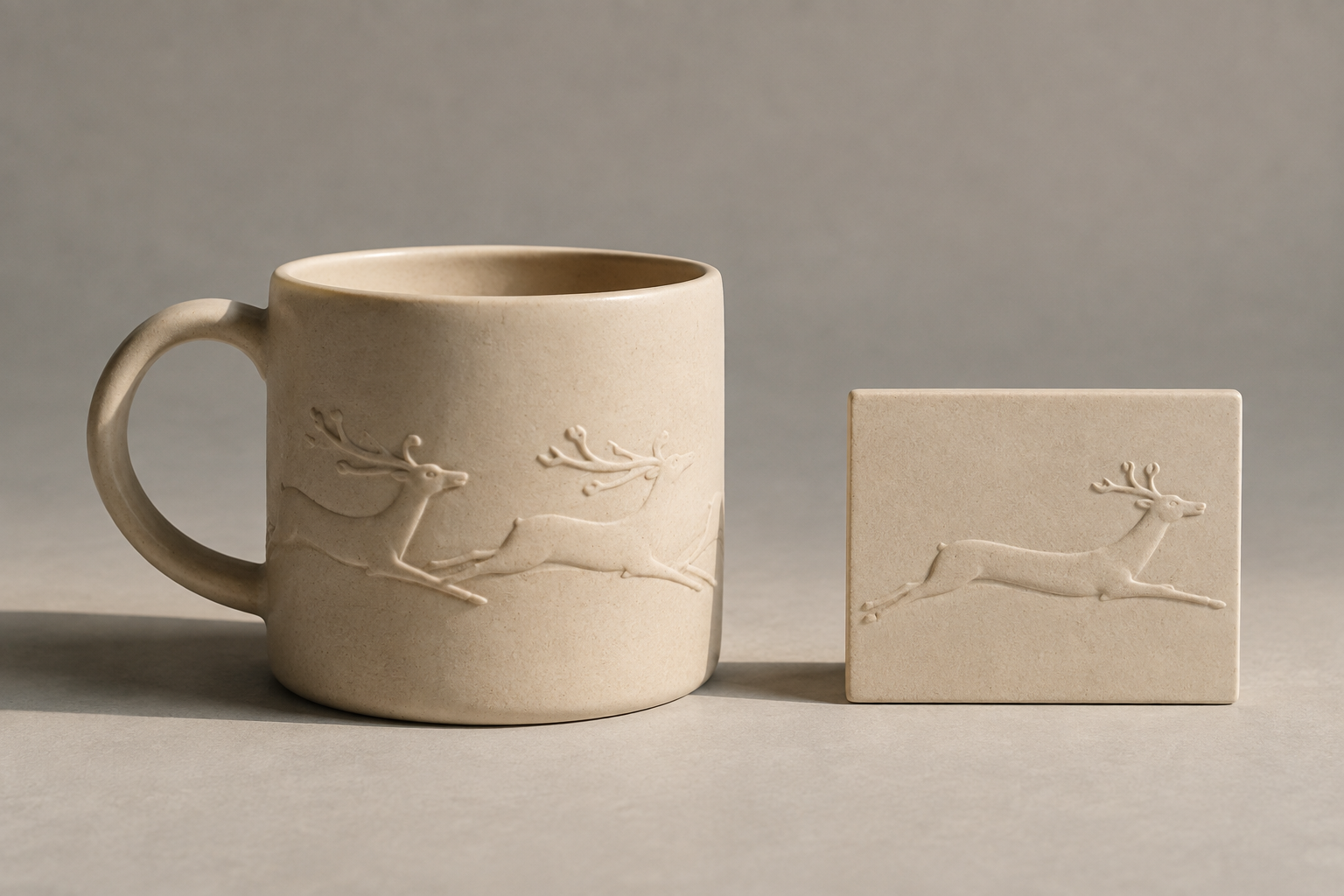
Contemporary relief exploration generated with AI: elongated reindeer silhouettes interpreted as a circulating ceramic frieze. An illustrative design direction, not a historical reconstruction or a manufactured prototype.
Keep the movement; edit the detail
Start with the outer line at the size it will actually occupy on the cup. If the motion is lost there, adding tiny marks will not recover it. Make the animal readable before adding a second one.
For a first FORM study, place a pair of contours on a broad, quiet band. Leave a gap before the pattern repeats, and position the wrap join in that gap. Keep the antler branches stout and simple. Fine intersections may look clear on screen but merge visually once the surface and glaze change the light.
Try a groove and a raised line at the same scale. Compare the silhouette, not just the shadow. A depth map can suggest carving, but it cannot automatically reproduce the original sculpture’s independent volume. Inspect the resulting cup and mold analysis before deciding how to fabricate it.
The most interesting inheritance here may be a compositional habit: let one thing lead to another. A cup does not need a prehistoric animal on it to learn from the way these two share a line.
Further reading
- British Museum: Swimming Reindeer, Palart.550 — material, identification, excavation, and recognition of the join.
- Wikimedia Commons: photograph by Val — original photograph and attribution. The filename says “Sleeping”; the museum object is the Swimming Reindeer.
- CC BY-SA 2.0 license — applies to the photograph. The separate cup illustration is a contemporary design study, not a photograph of an archaeological object.