
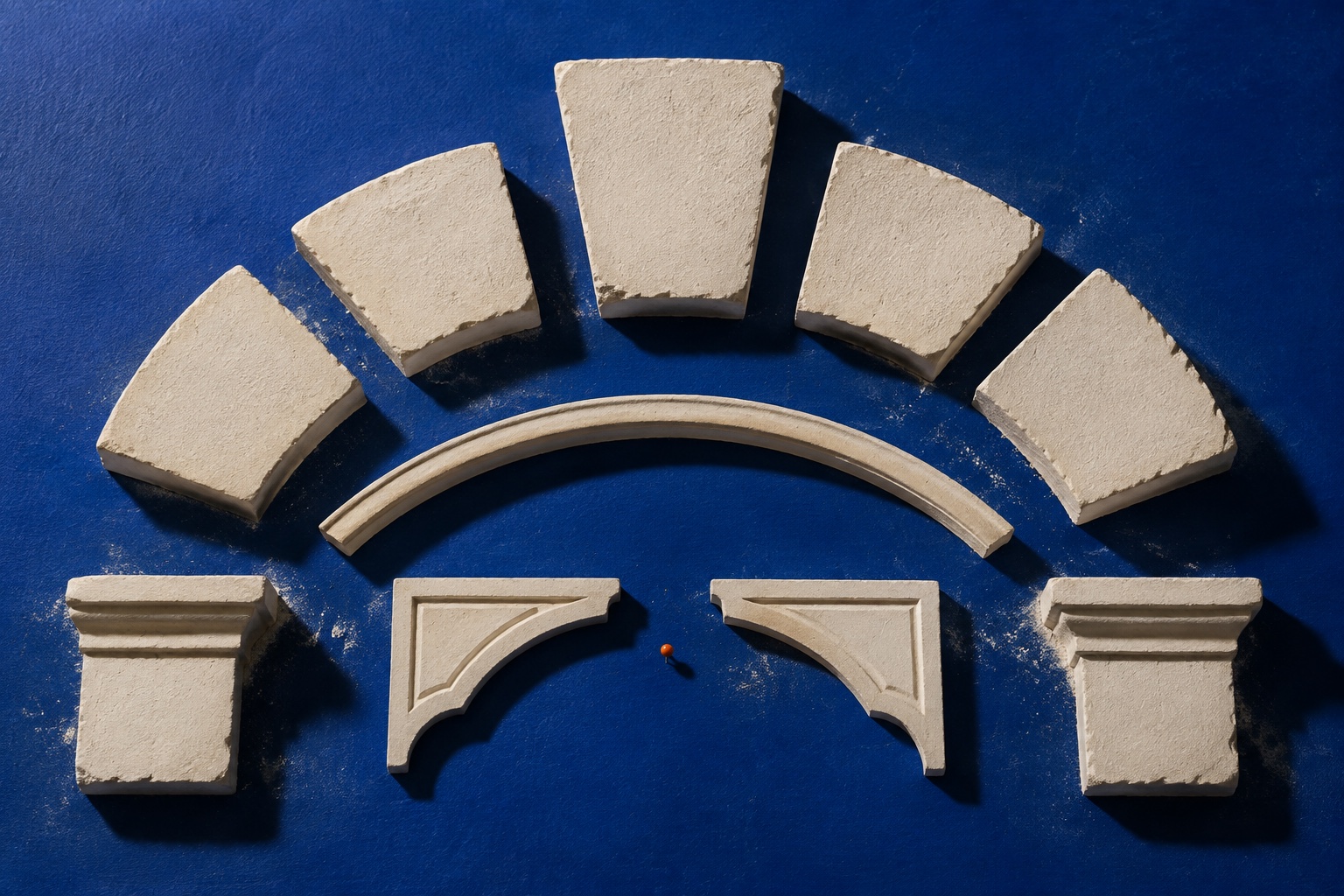
A curve becomes easier to design when its structural pieces, ornamental bands, and surrounding fields have separate names. Contemporary plaster study created for FORM.
“Arch” is enough to identify the family. It is not enough to describe the design. The useful language begins when the curve is separated into blocks, boundaries, supports, and the fields around it.
Read the arch from the inside out
Start with the opening itself. Its concave underside is the intrados. The corresponding outer curve is the extrados. Between those two boundaries sits the body of the arch, traditionally assembled from wedge-shaped units called voussoirs.
At the apex, one voussoir may be emphasized as the keystone. At the sides, the curve begins at the springing line and transfers into the support through an impost or impost block. These terms describe structure, but they are also powerful compositional controls: a keystone can be enlarged, an impost can become a horizontal register, and the depth between intrados and extrados can become the main relief band.
Unit
Voussoir
A wedge-shaped masonry element within an arch. In a relief pattern, visible joints between voussoirs create rhythm and can make a smooth curve feel assembled rather than drawn.
Apex
Keystone
The central voussoir at the crown. It often becomes a focal point because its position is already visually privileged, even when the arch is represented decoratively rather than structurally.
Transition
Springing line
The horizontal level where the arch begins to curve away from its supports. Naming it helps control where vertical order gives way to radial order.
Support
Impost
The block, capital, or moulded course from which the arch springs. It can be quiet and structural or deliberately pronounced as a ledge.
Boundaries
Intrados / extrados
The inner and outer curves of the arch. Treating them as separate lines makes it possible to vary thickness, taper, and shadow along the band.
Frame
Archivolt
A moulding or ornamental band that follows the curve around an arched opening. Multiple archivolts produce nested depth and a strong approach toward the opening.
Field
Spandrel
The roughly triangular area between an arch curve and its rectangular surround, or between adjacent arches. It is often where secondary relief or contrasting texture lives.
Shape is only half of the description
An arch type names the large geometry: round, segmental, pointed, horseshoe, ogee. The vocabulary above names the relationships within that geometry. Combine both levels when documenting a reference:
A shallow pointed arch with two stepped archivolts, narrow voussoirs, an enlarged keystone, and smooth spandrels.
That sentence is far more searchable—and far more reproducible—than “ornamental Gothic arch.” It identifies the curve, the repeating units, the focal element, and the contrast between worked and quiet areas.
Further reading