
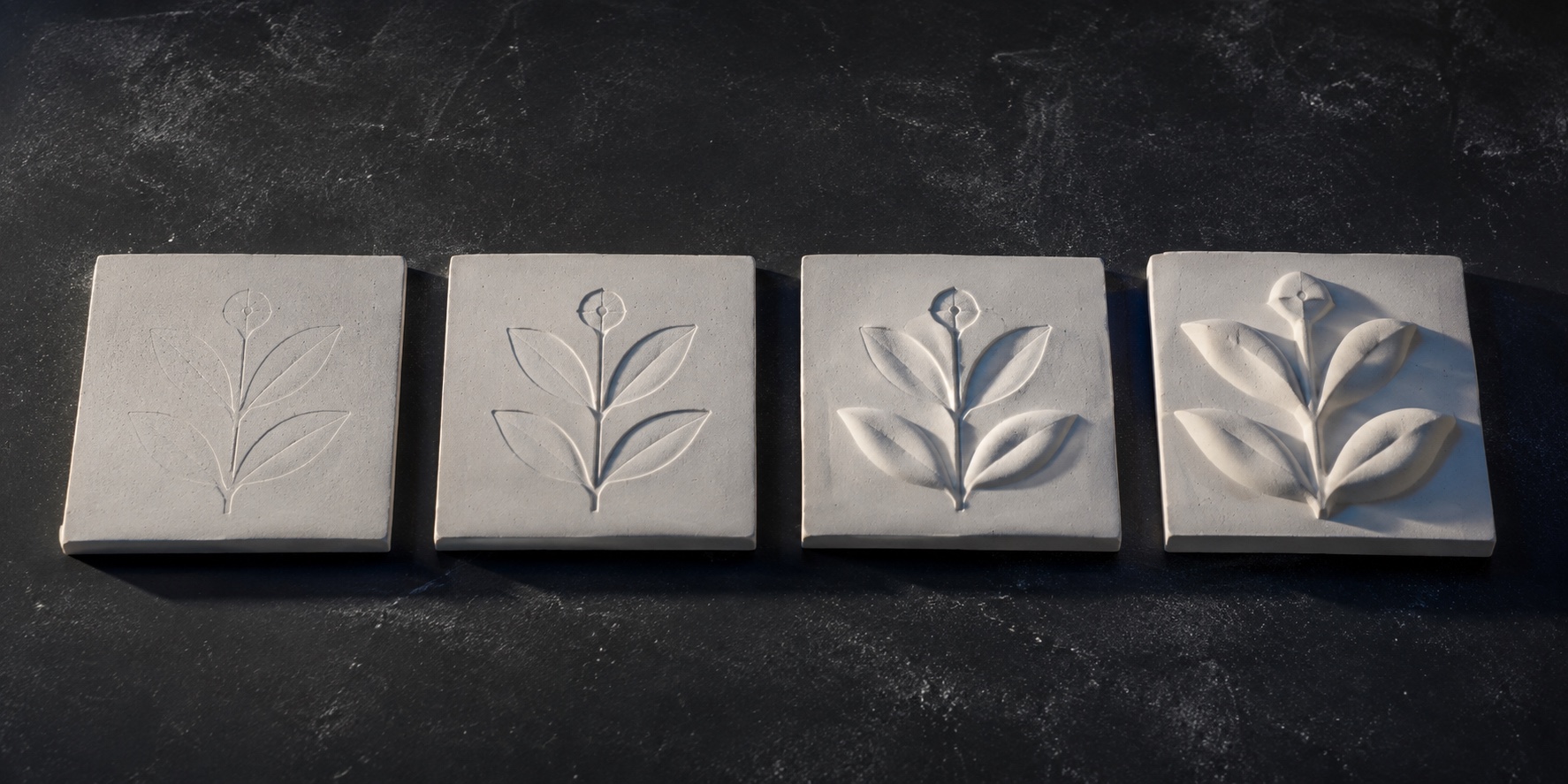
The same motif behaves differently as projection and edge angle change. Contemporary plaster study created for FORM.
Relief sculpture occupies the territory between a flat image and sculpture in the round. Its forms remain attached to a ground, but there is no universal measurement at which low relief suddenly becomes high relief.
Begin with the ground
The most useful question is not “how many millimetres deep?” but “what happens to the ground plane?” In raised relief, the represented forms project from a lowered or retained background. In sunk relief, contours are cut into the surface while much of the original face remains present.
Ancient Egyptian carving makes this difference especially legible. The Metropolitan Museum of Art’s teaching material distinguishes raised relief—where the field around the figures is lowered—from sunk relief, where outlines are recessed. Both can contain minute internal modelling, so “sunk” does not mean visually flat.
Four working descriptions
Shallow projection
Low relief
Forms remain close to the ground. Silhouette, overlap, and small changes in plane carry more information than deep cast shadows. The French-derived term bas-relief is commonly used for this family.
Strong projection
High relief
Forms project decisively and may approach sculpture in the round while remaining attached to a ground. Deeper occlusion and overlap make lighting direction more dramatic.
Field lowered
Raised relief
The figure or ornament stands proud of its surrounding field. This broad description can include both low and high degrees of projection.
Contour recessed
Sunk relief
The principal surface is retained while outlines and selected internal passages are cut below it. Raking light collects inside the incisions rather than beneath projecting edges.
Translate the distinction into a height field
In a grayscale depth map, white and black only become useful after you decide what they mean. If white represents the highest point, a raised-relief map usually keeps the background dark and builds lighter forms above it. A sunk-relief map can invert that logic: preserve a light field and draw darker channels into it.
The edge profile matters as much as the value range:
- A narrow transition produces a crisp shadow and can behave like a cut edge.
- A wide transition reads as swelling or modelling.
- A flat white plateau creates a shelf rather than a rounded peak.
- Small value changes inside a large form preserve modelling when the total relief must stay shallow.
Light is part of the model
Historical reliefs were designed for particular viewing distances and changing light. The Met’s Eagle Relief describes a multi-level composition whose angled feathers and bevelled scroll edges intensify shadow. That observation transfers directly to digital authoring: a surface is not resolved until it has been examined under moving, raking light.
Further reading