
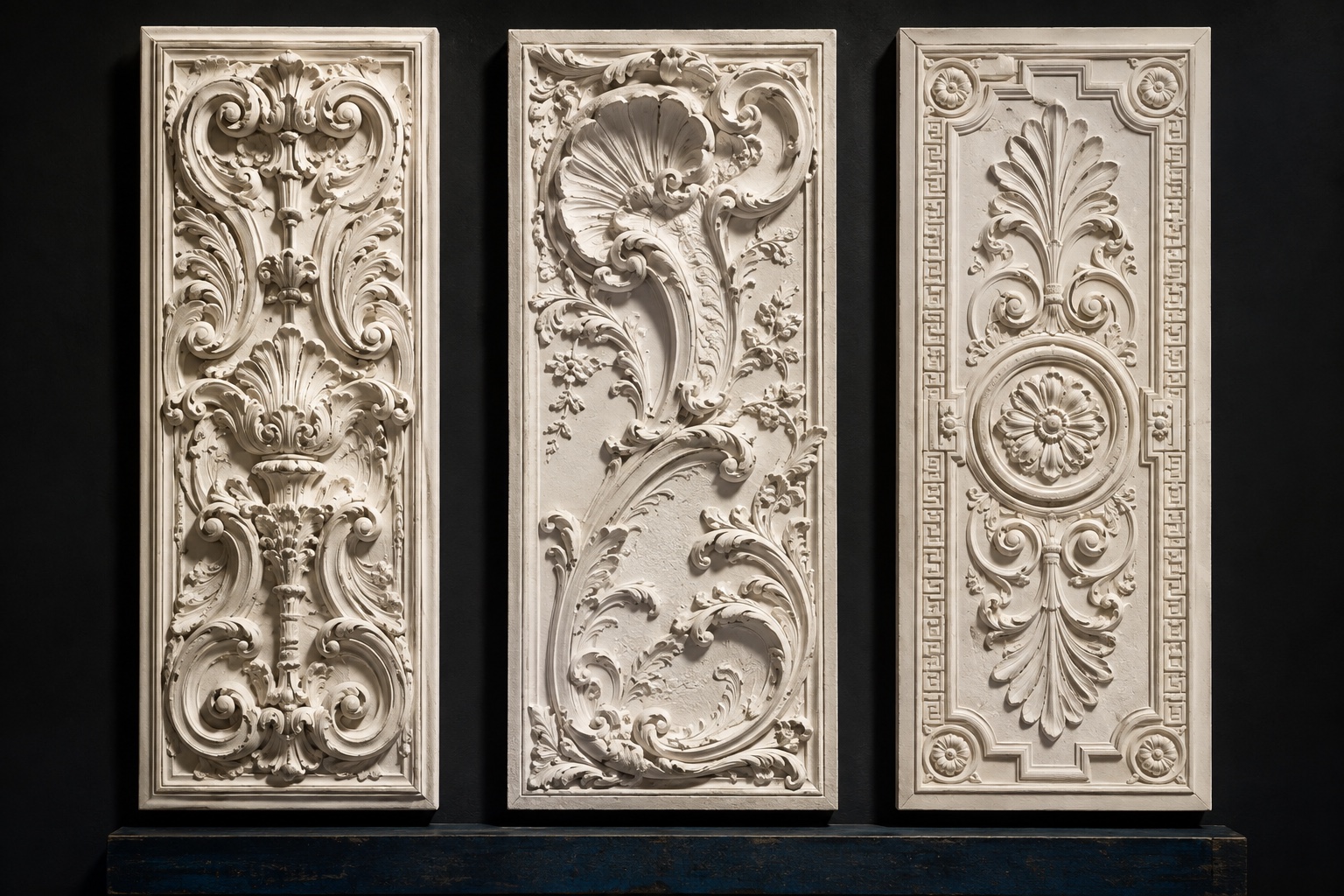
Style names are most useful when they identify a system of proportion, rhythm, and ornament—not when they are pasted onto a single motif. Contemporary comparative study created for FORM.
“Classical,” “Baroque,” and “Rococo” are often used as mood words. They become more useful when they tell you where symmetry sits, how ornament moves, and whether the parts submit to an overall order.
Compare systems, not decoration counts
More ornament does not automatically mean Baroque. A shell does not automatically make a design Rococo. A rosette is not exclusively Neoclassical. Look at the relationships: axial or asymmetrical, contained or overflowing, architectural or organic, repeated or continuously varied.
Baroque
Forms gather into a persuasive whole. Curves turn into counter-curves, axes are emphasized, and sculpture, architecture, and surface decoration often work together rather than as isolated layers.
Rococo
Lighter, irregular, and often intimate. Look for S- and C-curves, shells, rock-like rocaille, scrolling foliage, and compositions whose two halves intentionally refuse to mirror each other.
Neoclassical
Ornament returns to disciplined axes and repeated antique-derived motifs: urns, swags, palmettes, rosettes, fluting, and fine continuous bands held within a clear framework.
Gothic Revival
Medieval architectural language is reinterpreted through pointed arches, cusps, tracery, quatrefoils, crockets, and clustered verticals. Revival work ranges from archaeological study to deliberately fanciful mixtures.
Arts and Crafts
Less a fixed ornament kit than a set of ideas about making. Pattern often grows from observed plants, visible construction, and the belief that design and craft should remain connected.
Three fast diagnostic questions
1. Where is the axis?
Neoclassical ornament usually makes the centre and its balancing halves easy to find. Baroque design may keep the axis but energize it through diagonals and projecting masses. Rococo ornament is comfortable allowing the visual centre to drift.
2. What kind of curve dominates?
Baroque curves feel volumetric and architectural. Rococo curves branch, curl, and dissolve into shells or foliage. Neoclassical curves are more likely to be bounded inside medallions, garlands, or repeated borders.
3. Does the ornament obey the frame?
Neoclassical ornament tends to reinforce panels and registers. Baroque ornament can merge with the architecture to intensify the whole. Rococo ornament often appears to grow across or around a frame, making the boundary feel provisional.
Build a reference trail
Begin broad, then make the query concrete. “Rococo ornament” becomes “British Rococo shell cartouche pattern print 1750s.” “Gothic” becomes “Gothic Revival quatrefoil plasterwork.” The extra nouns and dates produce references that can be compared instead of a feed of loosely related decoration.
Further reading