
Before looking at the extravagant rim, look lower. Across the body of this pot, small repeated marks hold the memory of a hand pressing a cord into soft clay. The decoration begins with an action.
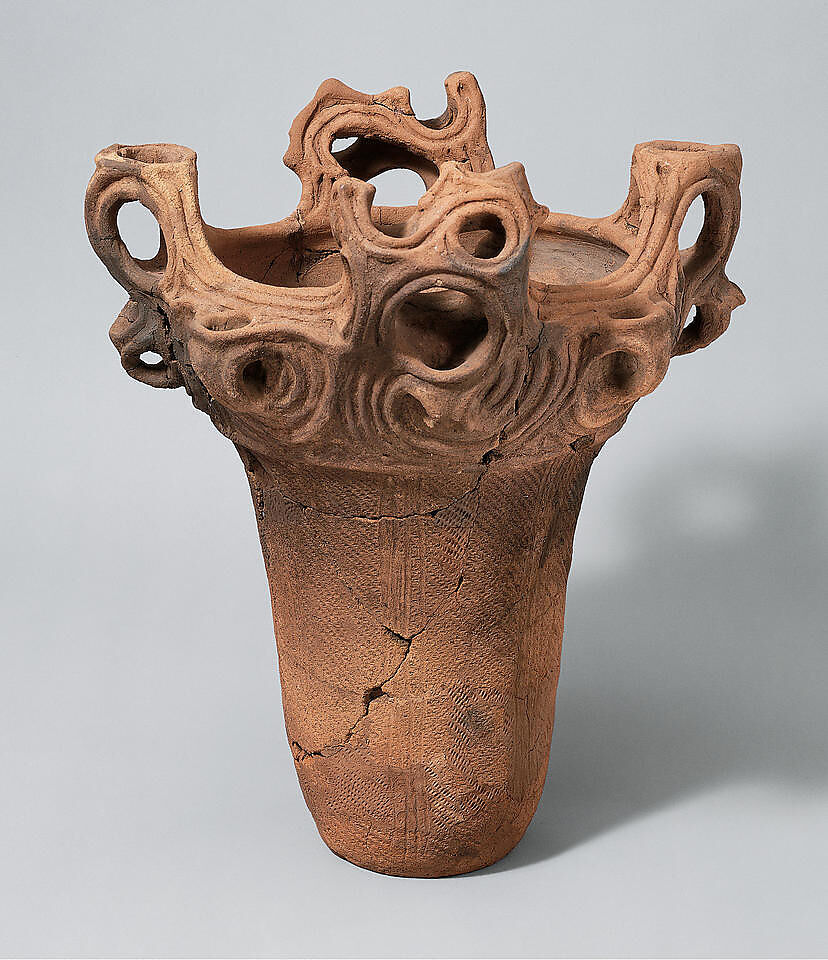
‘Flame-Style’ Deep Pot (Kaen doki), Japan, Middle Jōmon, 3500–2500 BCE. Earthenware; height 53.1 cm. Mary Griggs Burke Collection, Gift of the Mary and Jackson Burke Foundation, 2015.
An ordinary tool, an extraordinary surface
The name Jōmon refers to cord markings. At The Met, this particular vessel pairs a textured body with a dramatic mouth: applied coils rise into loops and openings. It was built by hand. The museum notes a delightful detail: the cord impressions can be seen in X-ray images too. A surface gesture becomes something a conservator can read through the object. The pot has also been restored; what we see today includes a history of repair. The Met’s object record.
Try following one ridge with your eyes. It rises, doubles back, disappears behind another piece of clay. Then look at the quieter lower body. The contrast matters. If everything were equally emphatic, the rim would lose its force. Here, small texture and large silhouette ask for different kinds of attention: one from a distance, the other from close by.
A landscape changes; ways of living change
These vessels belong to communities with long histories of gathering, fishing, and hunting. The Met’s overview describes settlements of pit dwellings and the changing resources of a warming, postglacial landscape. Rising seas reshaped coastlines; shell middens preserve evidence of food and daily activity. Pottery sits within that material world, alongside baskets, tools, and the work of preparing and storing things. The Met, Jōmon Culture.
That context changes the way we might approach the surface. A cord is not an abstract design device invented for a graphics library. It belongs to a world of materials handled, twisted, joined, and put to work. Our interpretation is that this pot makes the action of making unusually legible. The ornament feels active because the eye can imagine a sequence of touches.
This does not mean that climate directly produced a particular curl, or that we can explain every opening in the rim. Environmental history helps locate the makers’ lives; it does not supply a complete dictionary of their intentions.
Borrow a gesture, then change its scale
Before translating the first pot into a cup, compare it with another vessel from the same broad period.
Another Jōmon voice: a band that crowns the body
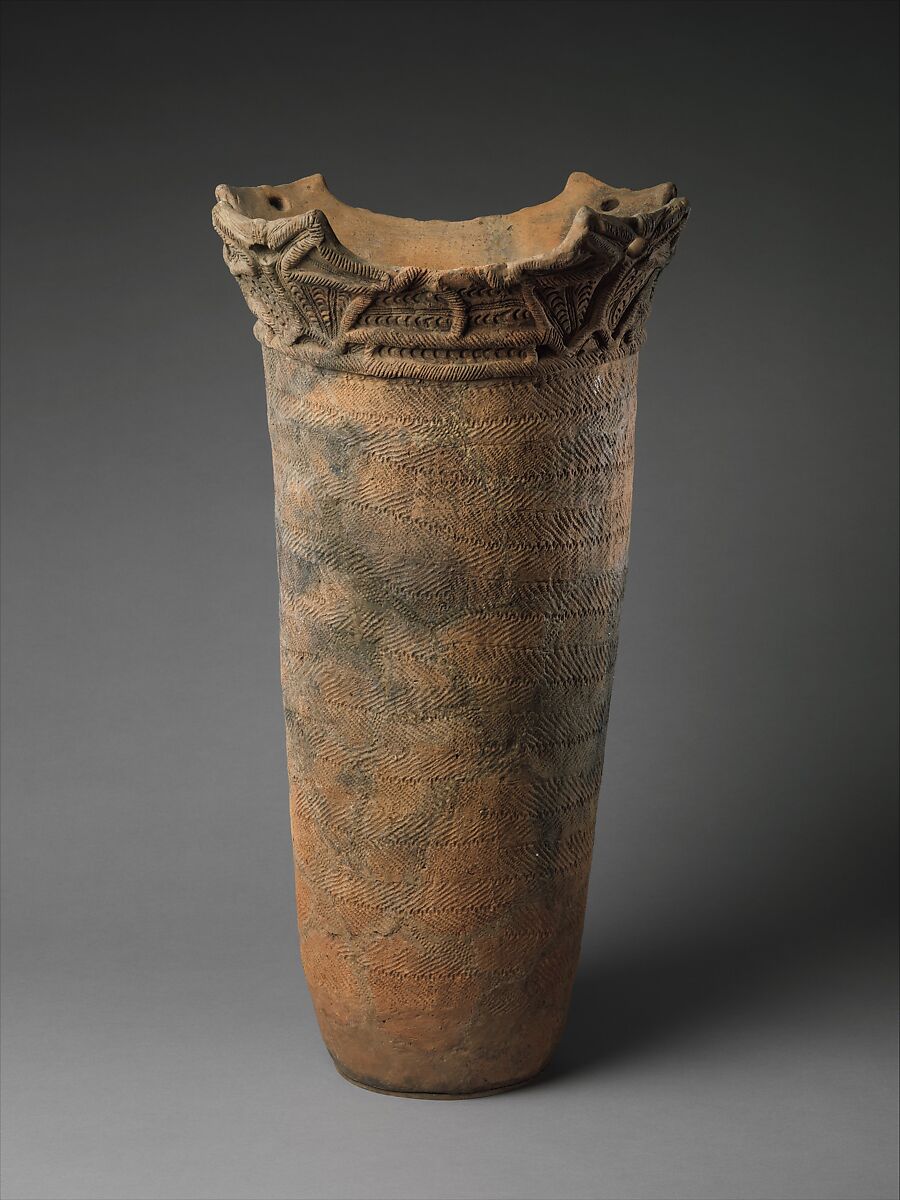
Deep Cylindrical Vessel (Fukabachi), Middle Jōmon, ca. 3500–2500 BCE. Earthenware with cord-marked decoration and sculptural rim; height 69.8 cm. The Met, 1975.268.182, Harry G. C. Packard Collection of Asian Art, 1975.
This second vessel at The Met shares the first pot’s period and cord-marked technique, but its visual balance is different. Fine impressions occupy a long body; larger relief gathers near the mouth. Look at how much work the change of scale does. A cup study could retain that hierarchy with a narrow sculptural band above a field of much shallower texture. The placement would be our interpretation, with the drinking edge left smooth.
From comparison to a cup
A drinking cup offers a useful design problem. A spectacular pierced rim draws the eye, but the lip of a cup also has a job to do. We can move the visual energy down the body, leaving the drinking edge calm. The translation need not copy the museum object’s silhouette.
In the study below, alternating strokes become a broad band. They are deliberately simplified: this is a new geometric rhythm prompted by cord impressions, not a tracing of the ancient pattern. Switch between raised and incised lines. A dark groove and a bright ridge can describe a similar drawing, while suggesting a very different touch.
From history to cup / FORM study
A surface that keeps the gesture
Cord impressions → alternating strokes → a tactile band
01 / The repeat, unfolded
Keep the energetic rhythm below a quiet drinking rim. Change the direction of the marks instead of covering every part of the cup.
Original FORM illustration, inspired by the object discussed above. Schematic lighting and placement, not a reconstruction or a mold-readiness result.
Imagine it in clay
Here, the cord gesture becomes a field of diagonal impressions, balanced by one curling ridge. The matching tile isolates the surface experiment; the cup shows how that texture can sit below a smooth drinking rim. This is another possible interpretation, rather than a rendering of the interactive diagram above.
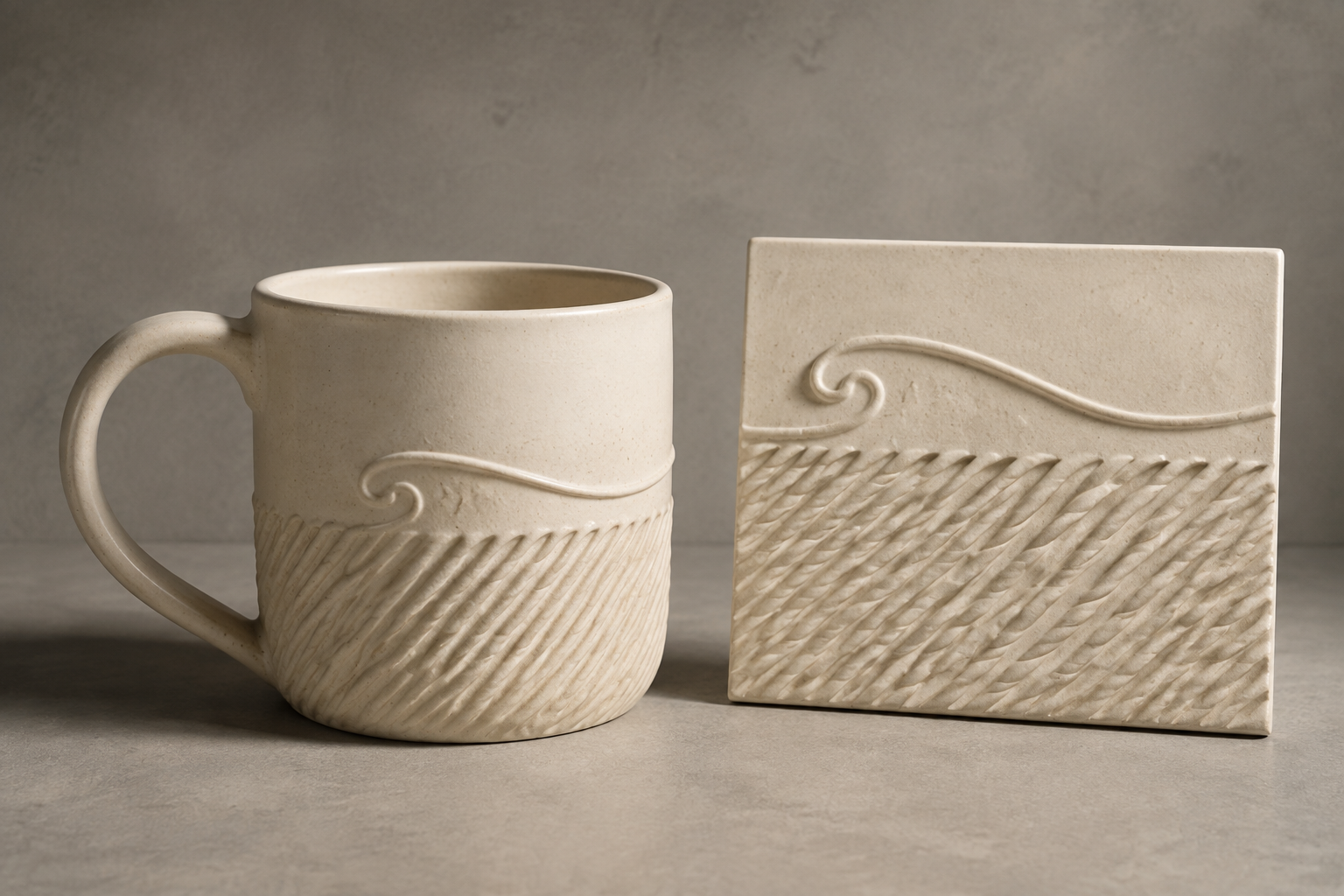
Contemporary relief exploration generated with AI: cord-like impressions and a curling ridge translated into a cup and test tile. An illustrative design direction, not a historical object or a manufactured prototype.
Try it in FORM
- Make a small repeat from diagonal strokes. Reverse the direction in the next row; leave enough space for each mark to remain distinct.
- Build the motif as a grayscale depth map. Soften the transitions if you want rounded ridges rather than abrupt steps.
- Place the band below the rim in the form workbench. Leave a smooth area where the fingers and handle meet the body.
- Compare a sparse version with a dense one under the same light. Check the relief and mold release using the app’s analysis, then test the surface in your chosen clay and glaze.
The useful question is not “does this look ancient?” It is “can someone still sense the gesture?” A cup can carry that question without pretending to be a Jōmon vessel.
Further reading
- The Met: Flame-Style Deep Pot, 2015.300.258 — object date, material, construction, X-ray observation, and collection credit.
- The Met: Jōmon Culture, Department of Asian Art, 2002 — environmental and settlement context; its phase dates differ from the current object record.
- The Met: Open Access image policy — the historical photograph is an open-access image; the cup diagram is a separate FORM interpretation.