
A boat stretches across the belly of a jar. Its oars make a rhythm; triangles line the ground below. Long before the familiar monuments of pharaonic Egypt, a vessel could already hold an image of a connected world.
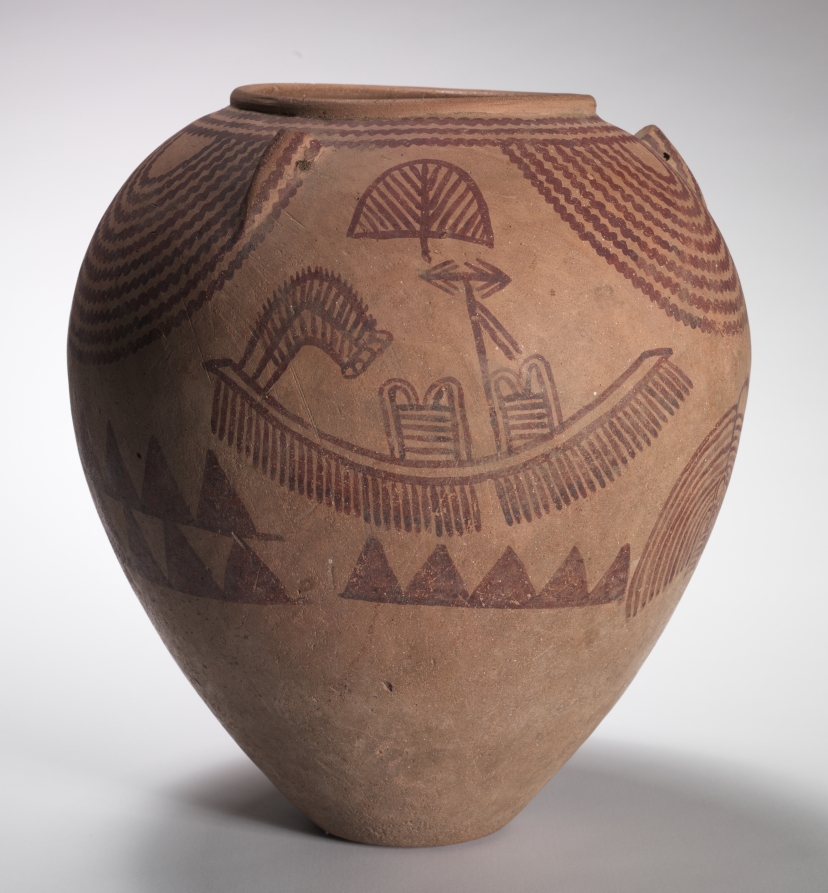
Decorated Jar with Boat Scenes, Predynastic Egypt, fourth millennium BCE. Marl clay pottery; height 32 cm. Gift of the John Huntington Art and Polytechnic Trust, Cleveland Museum of Art, 1914.639.
Read the river before the symbol
The Cleveland Museum of Art identifies two many-oared boats, plants along fertile banks, and triangles indicating desert hills. It places this imagery in a landscape where the Nile enabled transport and communication more efficiently than overland travel. This is a useful starting point: the river connects places before we ask what any particular sign might mean. Cleveland’s object record.
Look at the relationship between the lines. The hull sweeps upward at either end, while the oars subdivide its length. The small repeated strokes make the great curve feel even longer. Above and below are other registers of marks, so the boat has a setting without needing a single, framed viewpoint.
For a designer, that is already a substantial idea. A landscape can be organized as rhythms rather than rendered as a window. Repeated short marks can carry one role, a continuous curve another, and an area of bare clay a third.
Images in a changing society
The Met’s exhibition The Dawn of Egyptian Art followed the Predynastic and Early Dynastic periods, when images made for shrines and tombs expressed changing beliefs. Some early forms contributed to hieroglyphic signs; others persisted through pharaonic art. The important connection is between visual habits and institutions taking shape over time, rather than a sudden invention of “Egyptian style.” The Met’s exhibition overview.
Do not read that later history backward as a complete explanation of this jar. A painted boat is not automatically a known god’s boat, and an early image is not simply an unfinished hieroglyph. It belongs to its own moment. The river’s practical importance gives us context; it does not settle every question about the scene’s use or meaning.
The boat you cannot see yet
Another Predynastic surface: let the form speak
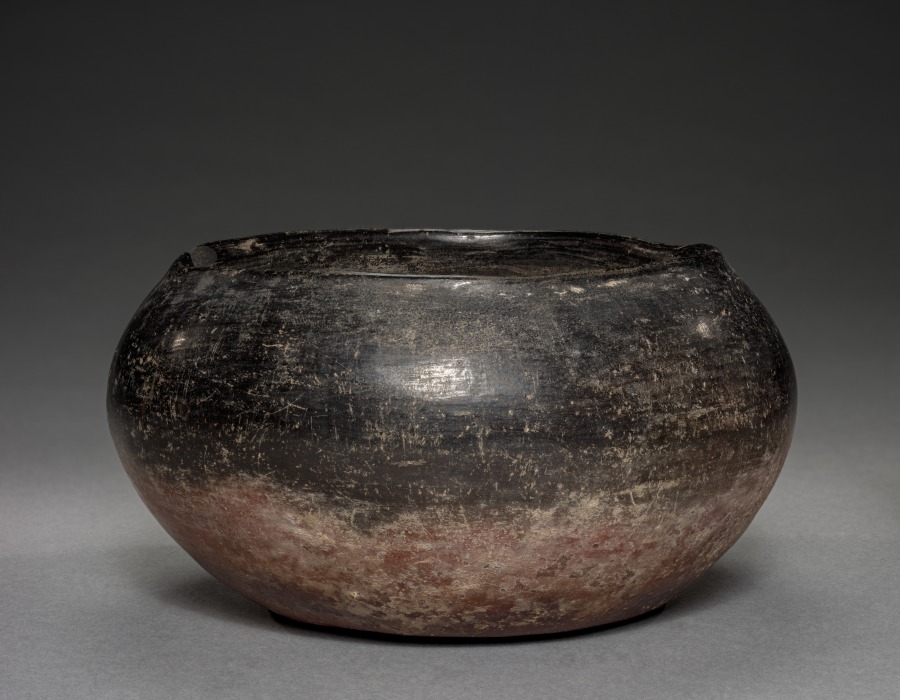
Black-Topped Bowl, Predynastic Egypt, 4000–3000 BCE; catalogued as Naqada II. Nile silt; height 7.6 cm. Cleveland Museum of Art, 1920.2006. Gift of the John Huntington Art and Polytechnic Trust.
This bowl in Cleveland’s collection offers a contrast within Predynastic pottery, rather than another example of the boat-painted style. Its dark upper surface and rounded profile carry the visual interest. Seeing it beside the decorated jar keeps us from treating a period as one pattern book.
For a contemporary cup, the lesson could be restraint: one small relief on a generous uninterrupted body, or a textured lower band beneath a quiet upper surface. The bowl’s color is not a height map; translating its contrast into relief would be a new design decision. Sometimes a related object is useful precisely because it suggests what to leave out.
Back to the painted jar
Here is a small surprise in the catalogue: it describes two boats, while the main photograph presents one dominant boat scene. The vessel has more to show than a single image can comfortably contain. That is an invitation to think about the back of an object, the part the usual photograph leaves out.
On a cup, turning is part of reading. A composition can acknowledge that movement. A band might reveal a hull first, then a quiet interval, then a second motif. The handle interrupts the journey; it can become a deliberate pause instead of an obstacle disguised by pattern.
From history to cup / FORM study
A journey, read by turning
Painted boats → a curved hull and repeated oars → a relief register
01 / The repeat, unfolded
Use the hull as the main line and the oars as its rhythm. The interpretation turns painted marks into low relief; the ancient jar itself is painted.
Original FORM illustration, inspired by the object discussed above. Schematic lighting and placement, not a reconstruction or a mold-readiness result.
Imagine it in clay
The painted hull becomes a raised curve, and the oars become a sequence of small shadows. A matching test tile shows the motif before it meets the cup’s round body. The generous bare surface is part of the composition: it lets a single journey hold the eye.
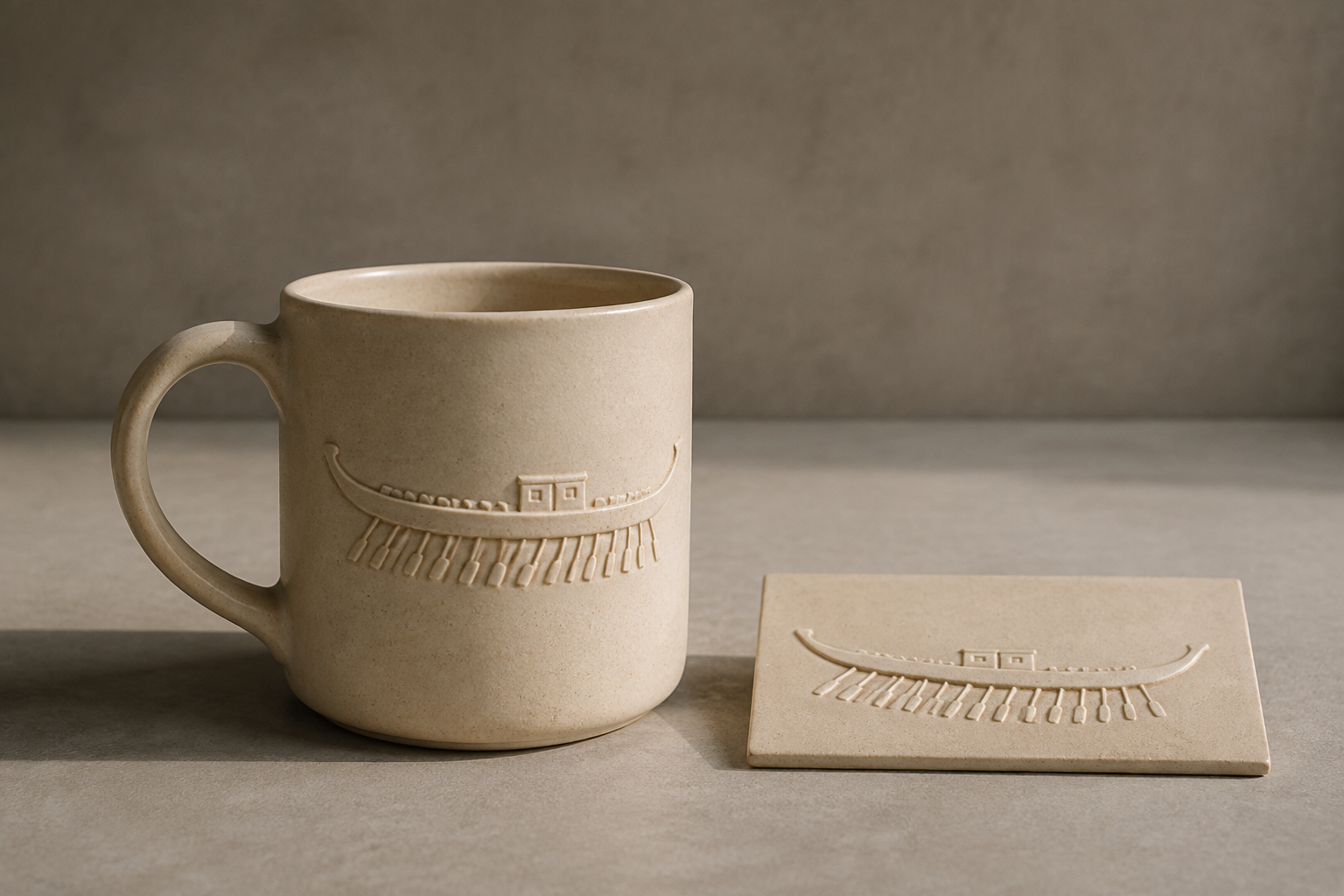
Contemporary relief exploration generated with AI: a painted boat motif reimagined as raised ceramic detail. An illustrative design direction, not a Predynastic artifact or a manufactured prototype.
From pigment to depth
The ancient decoration is painted. Translating it into relief is our design choice, not a claim about the historical technique. In the study, we keep only the curved hull and the rhythm of the oars. The simplified cabins give the eye a place to rest. We omit religious emblems rather than attach a speculative meaning to them.
Build the principal curve first in FORM, then add the short strokes as a second level of detail. Use a narrow grayscale range for a restrained surface and inspect the actual height settings in the modeler. A museum photograph’s shadows are lighting, not measured depth: simply converting that photograph to grayscale will not isolate the painted design.
Leave space below the drinking rim and around the handle. Check that the ends of the composition meet intentionally at the wrap. Finally, examine draft and release in the chosen mold arrangement; a pleasing drawing is only one part of a workable ceramic object.
This approach can travel beyond boats. Ask what made a place connected: a river, a road, a port, a route across mountains. Then ask how its artists made those relationships visible. History supplies a richer starting point than a catalogue of isolated ornaments.
Further reading
- Cleveland Museum of Art: Decorated Jar with Boat Scenes, 1914.639 — material, dimensions, iconography, transport context, and the dating discrepancy noted above.
- The Met: The Dawn of Egyptian Art — the changing visual world of the Predynastic and Early Dynastic periods.
- Cleveland Museum of Art: Open Access — CC0 image reuse policy.